
Unified supplier profiles
Contacts, categories, certifications, banking and performance history in one record.
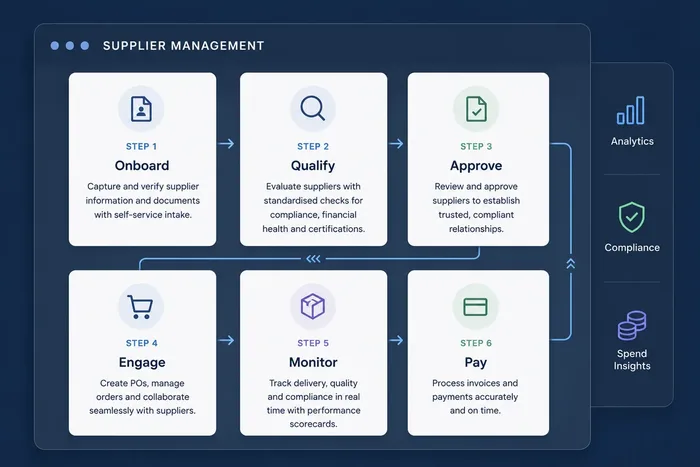
Discovery, onboarding, qualification and performance - unified so your team always works from the same current view of every supplier.
Contacts, categories, certifications, banking and performance history in one record.
Guided self-service intake cuts onboarding time from weeks to days.
Standardized checks for compliance, certifications and financial health.
Scorecards on delivery, quality and responsiveness, visible across the org.
Guided self-service supplier onboarding with document verification.
Learn moreConfigurable checklists for compliance, quality and financial due diligence.
Automated scorecards blending delivery, quality and responsiveness data.
Continuous financial, compliance and geopolitical risk signals per supplier.
See Supplier Risk ManagementBidirectional sync with SAP ECC/S4HANA/Microsoft Dynamics etc. keeps vendor records consistent everywhere.
Self-service access to POs, invoices, documents and onboarding status.
Supplier records connect natively to sourcing, contracts and invoicing - one data model throughout.
Most organisations do not have one supplier record. They have several. Procurement holds a qualification file, finance holds the payment master, quality holds certifications and audit results, and the category manager holds the relationship history in their head and their inbox. Each is accurate about its own slice and none is complete.
The cost surfaces at the worst moments. A supplier is re-qualified because nobody could find evidence they already were. An expired certification is discovered during an audit rather than before it. A category manager leaves and takes the working knowledge of a strategic relationship with them. And the question that should be simple - how much do we spend with this supplier across the whole group, and how are they performing? - takes a week and a spreadsheet.
A single live record changes what the data is for. Discovery, onboarding, qualification, performance and risk write to the same profile, so the record reflects the current state rather than the last time someone updated their copy. That is what makes supplier data usable in a negotiation rather than only in a report.
Who uses it. Category managers, who need history and performance before a negotiation. Procurement operations, who maintain the record. Compliance and quality, who need current certifications. Finance, who need the payment master to be right.
What it connects to. It is the hub the rest of the supplier workflow hangs off: onboarding creates the record, risk monitoring updates it continuously, sourcing events draw eligible bidders from it, and the ERP vendor master stays in sync through the integration layer rather than being maintained twice.
What it does not do. It will not tell you which relationships deserve investment. That is category strategy - a supplier can be well-managed and still be the wrong supplier for the quadrant the category sits in.
Onboarding, qualification and risk monitoring, walked through on your supplier base.