
ERP
Purpose-built SAP ECC/S4HANA and Microsoft Dynamics 365 Business Central connectors for vendor master, PR/PO, GRN and invoice posting.
Deep, bidirectional connectors for ERP and business systems, plus documented REST APIs and e-Signature integrations - so procurEngine fits your existing systems landscape, not the other way around.
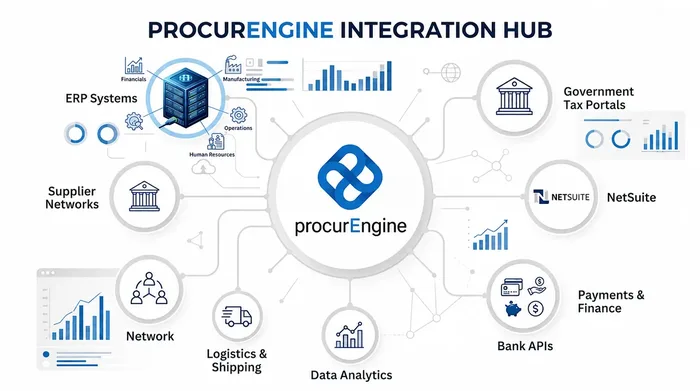
Purpose-built SAP ECC/S4HANA and Microsoft Dynamics 365 Business Central connectors for vendor master, PR/PO, GRN and invoice posting.
Native e-sign, or connect your existing provider via API.
Documented REST APIs for custom integrations with any internal system.
Standard SSO protocols for enterprise identity provider integration.
Export procurement data to your data warehouse or BI tools via API.
Flexible OTP-based login through email and WhatsApp ensures secure, frictionless access while maintaining user identity verification.
The connectors are purpose-built by procurEngine and configurable per object, not a generic file drop or a field-mapping exercise. They run over SAP middleware (PI/PO for on-premise licences, CPI for cloud), so your SAP team keeps the integration layer it already governs.
| Object | Direction | What it means in practice |
|---|---|---|
| Vendor master | Bidirectional | Suppliers onboarded in procurEngine create or update the SAP vendor record, and changes made in SAP flow back - so neither system becomes a stale copy of the other. |
| Material master | Pull | Material records are pulled from SAP, so line items are raised against the codes and descriptions your ERP already holds rather than free text that has to be reconciled later. |
| Purchase requisition (PR) | Pull | Requisitions raised in SAP are pulled into procurEngine so they can be routed to a sourcing event, an existing contract or a catalogue without being re-keyed. |
| Purchase order (PO) | Push and pull | Orders can originate on either side. Awards made in procurEngine push to SAP as POs; POs raised in SAP are pulled in for matching and visibility. |
| Goods receipt (GRN) | Pull | Receipts recorded in SAP are pulled in, so three-way matching runs against the receipt your finance team already trusts. |
| Service entry sheet (SES) | Pull | Service confirmations recorded in SAP are pulled into procurEngine - the service equivalent of a goods receipt, and usually the harder half of services procurement to control. |
| Invoice | Push | Matched, approved invoices push to SAP for posting and payment, carrying the match result and approval trail with them. |
Trigger and frequency are configurable per object. Each can run in real time, so a change propagates as it happens, or in scheduled batches where volume or system load makes that preferable. Most implementations mix the two - vendor master and PO in real time, invoice and GRN in batch - and the split is a configuration decision at implementation, not a product limitation.
Two things follow from the direction column that are worth reading carefully. PR is pull-only and SES is push-only, which means SAP stays the system of record for requisitioning while procurEngine owns service confirmation. And because PO moves both ways, an organisation can adopt procurEngine for sourcing without moving order creation, or move order creation across later, without re-implementing the integration.
Connector objects, sync design and the effort your SAP team needs are scoped against your landscape - ECC or S/4HANA, on-premise or Private Cloud, and how much has been customised. We work through that with your SAP lead rather than publishing one version that fits nobody.