
70-85% touchless
Most invoices match and post automatically, with no human intervention.
Automated three-way matching, exception routing and approval workflows - so your AP team spends time on exceptions that matter, not manual data entry.
Most invoices match and post automatically, with no human intervention.
Minutes instead of days per invoice, even at high transaction volume.
Automated duplicate detection catches errors before they reach payment.
Every match, exception and approval is logged for internal and statutory audit.
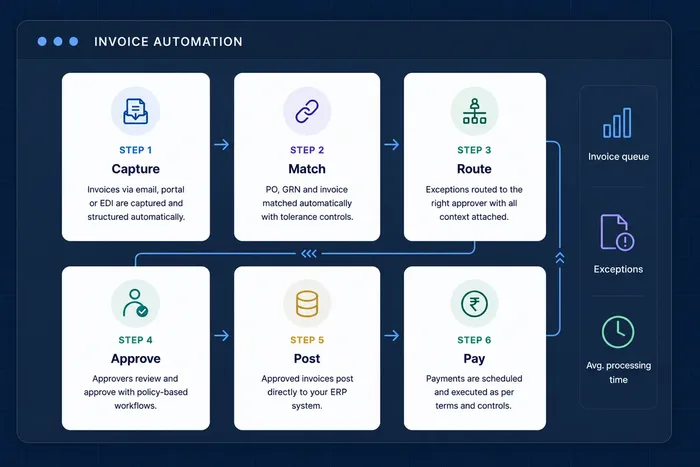
Invoices arriving via email, portal or EDI are captured and structured automatically.
PO, GRN and invoice matched automatically with configurable tolerance controls.
Mismatches route to the right approver with the relevant context attached.
Coding assistance and approval routing for invoices without a purchase order.
Automated checks flag duplicate invoices and suspicious payment requests.
Approved invoices post directly to SAP ECC/S4HANA or your ERP of choice.
Manual accounts payable is a matching exercise carried out by people. An invoice arrives, someone finds the purchase order, someone else confirms the goods were received, differences are chased by email, and the invoice is approved or held. Each step is simple. The volume is what makes it expensive, and the email chasing is what makes it slow.
The consequences reach beyond AP. Late payment is priced into the next quote and suppliers who expect delays build a buffer into their numbers, which shows up as a cost of goods problem rather than a process problem. Duplicate payments, which manual processes catch inconsistently, are recovered slowly if at all. And a close that depends on chasing is a close that cannot be shortened by adding discipline alone.
Automated three-way matching inverts the default. Purchase order, receipt or service entry sheet and invoice are compared automatically; anything agreeing within tolerance posts without human involvement, and only genuine exceptions route to a queue - with the order, the receipt, the contract and the approval history attached, so resolution is a decision rather than an investigation.
What makes this work is that the PO the invoice is matched against was raised from a contract that was awarded in a sourcing event on the same platform. Matching is only as reliable as the data upstream of it.
Who uses it. Accounts payable work the exception queue rather than the invoice pile; financial controllers care about close timing and duplicate prevention; procurement care because payment behaviour shapes what suppliers quote next time.
What it connects to. Purchase orders and receipts from Procure-to-Pay, contract terms from Source-to-Contract, and the ERP as system of record through purpose-built SAP ECC and S/4HANA connectors or documented REST APIs. See integrations.
What it does not do. It cannot match what was never ordered properly. A high touchless rate is downstream of PO discipline; invoices against vague or absent orders will always need a human.
Run it against your own invoice mix and see where the exceptions land.