
Benchmark-backed category savings
Competitive tension via structured e-Auctions and benchmark-backed negotiation targets. See how one customer applied this.
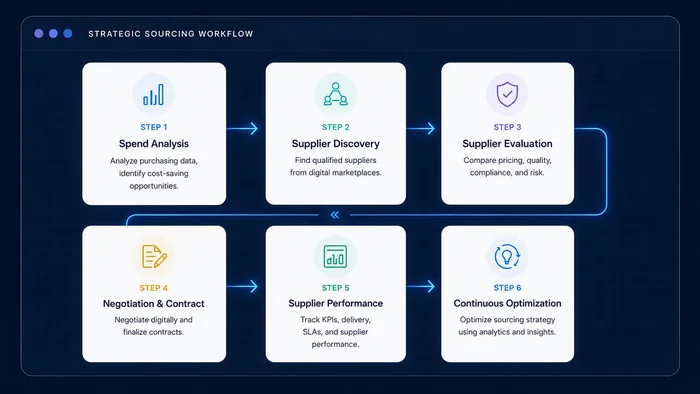
Structured RFx, competitive e-Auctions and AI-guided negotiation - replacing spreadsheets and email threads with a repeatable, auditable sourcing process.
Competitive tension via structured e-Auctions and benchmark-backed negotiation targets. See how one customer applied this.
Templated RFx and parallel evaluation replace weeks of manual email coordination.
Standardized, weighted scoring removes bias and makes awards defensible.
Every criterion, score and decision is logged - ready for internal or external audit.
Reusable, category-specific templates with weighted scoring criteria built in, customizable libraries for commercial, and technical clauses.
Live bidding with configurable rules, rank visibility and automatic extensions with variety of auctions for different categories and use cases.
Scenario modeling, offer benchmarking and counter-offer suggestions grounded in category data.
Commercial, technical and risk scoring with configurable evaluator panels.
Total cost of ownership views beyond unit price - logistics, quality cost and lead time.
Awards flow straight into contract templates - no re-keying between systems.
Most of these are reverse auctions - you are buying, and the price comes down. The last one runs the other way, for when you are selling.
Suppliers bid the price down in open competition. The classic reverse auction, and the basis for the freight and fuel variants below.
You set the price and move it step by step. At each step a supplier either accepts the offered price or declines it.
Also buyer-led: you move the price, and suppliers accept or decline the offer as it moves.
Suppliers bid a price and the quantity they will supply at that price, so volume and price are settled together rather than in sequence.
Suppliers offer price points with the quantity available at each. Used in our commodity sales case study to reach 400 small buyers directly.
An English reverse auction for logistics rates, run across lanes from one or several origins to multiple destinations. Generally awarded as a blanket or rate contract for a fixed period.
An English reverse auction where price alone cannot decide it. Bidders are ranked on price combined with calorific value, so a cheaper, lower-grade fuel does not win on headline price.
Multiple parameters combined in a mathematical expression you define. For complex categories where several variables move total cost of ownership, not just unit price.
Prices rise instead of falling and buyers compete. For selling non-moving or excess inventory, scrap and other disposables.
There is no default. The right choice follows from how many credible bidders you expect, the spread between your L1 and H1 suppliers, whether the category is a true commodity or specifications differ by supplier, how much quantity each supplier can actually cover, and whether you are evaluating line by line or at group level.
What bidders can see - rank only, best price, or nothing at all - is part of that strategy rather than fixed by the format.
Suppliers can bid in currencies other than your base currency, which widens participation from both local and international suppliers.
Bids are normalised for comparison at a rate set by your own policy - typically advised by the CFO or business finance controller - held constant through the event and reviewed before the order is finalised. Who carries any FX movement between award and PO is a matter of your contract terms, not platform behaviour.
On complex RFQs, offers often are not equivalent. Payment terms, delivery terms, warranty and AMC all change what a bid is actually worth, and comparing headline prices across them is not a like-for-like comparison.
λ-Factor normalises them. You define which deviations you will accept and what each is worth - in percentage points or absolute terms, consulting finance where the impact needs quantifying - and bids are evaluated on that adjusted basis rather than the raw number.
Publishing the factors in the RFQ is optional. Do it, and suppliers can see for themselves how a deviation would affect their evaluation before they bid.
Sourcing awards connect natively to supplier management, contracts and P2P.
We'll walk through a live RFx and e-Auction scenario for your category.