
Spend-Led Prioritization
Start from the top spend categories – classification effort should follow the money.
By Anupam Aggrwal, CEO & Co-Founder · 6 April 2026
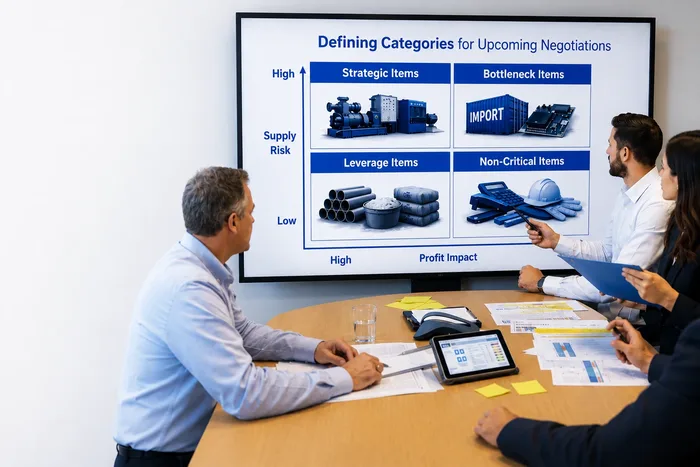
Classifying procurement categories correctly is the foundation of any effective negotiation strategy, and the Kraljic Matrix is one of the most powerful frameworks available for doing it. But knowing the framework is not the same as applying it. The real challenge is putting it to work on actual spend, category by category, in the middle of a busy procurement cycle.
Working with procurement leaders across EPC and manufacturing companies, the same gap appears repeatedly: the framework is understood, the application is not. Teams default to gut feel or past practice when the pressure is on, and the strategic value of category management is lost.
This whitepaper closes that gap. It walks through 20 real procurement categories from a mid-sized EPC company and shows how each one is classified, with the reasoning laid out in full so you can adapt the same logic to your own spend.
Negotiation strategy is downstream of category strategy. Until you know whether a category is a price battleground, a partnership, a continuity risk or an administrative overhead, every sourcing decision inside it is a guess. That is why classification is the first move, not a documentation exercise completed after the fact.
Working closely with procurement leaders across EPC and manufacturing organizations surfaces a consistent pattern. Teams can describe the Kraljic Matrix accurately. What they struggle with is applying it to a live spend base, category by category, in the middle of a busy procurement cycle. The framework stays on the slide; the buying reverts to habit.
The remedy is not a more sophisticated model. It is a worked example concrete enough to copy. The classification exercise that follows takes a few hours, not a quarter, and it changes how each unit of spend is approached for the rest of the year.
The matrix positions each category on two axes: the impact it has on profit or project cost, and the risk attached to its supply. Those two questions produce four quadrants, each with a distinct sourcing logic.
| Quadrant | Profile | Primary objective |
|---|---|---|
| Strategic | High profit impact, high supply risk | Partnership, reliability, joint problem-solving |
| Leverage | High profit impact, low supply risk | Competitive sourcing and consolidation |
| Bottleneck | Low profit impact, high supply risk | Continuity of supply and risk mitigation |
| Non-critical | Low profit impact, low supply risk | Automation and process efficiency |
A healthy EPC portfolio is rarely dominated by a single quadrant. If your classification puts almost everything in one box, the axes are probably being applied too loosely.
Do not try to cover everything. Start with the categories that carry the most relevance and the most value. In an EPC setting they group naturally into three families:
Twenty categories is enough to be representative and small enough to finish in an afternoon. The point is not completeness. It is getting the highest-value spend onto the matrix before the next sourcing cycle starts.
Apply Kraljic thinking to each category, and resist the urge to overanalyze. For every category, ask only two questions: how much does it move project cost, and how exposed are we on supply?
A few examples show how the reasoning runs:
Read down a completed reasoning column and a pattern emerges. Categories land in Strategic not because they are expensive, but because capability is scarce and switching is painful. They land in Leverage because standardization has created a competitive supply market. Bottleneck items are cheap and dangerous. Non-critical items deserve process, not attention.
That pattern is the transferable part. Once your team can articulate why a category sits where it does, the classification stops being an opinion and starts being a decision anyone can audit.
Once the categories are classified, the right strategy becomes largely self-evident. Yet this is precisely where most procurement teams leave value on the table: the classification is completed and then filed, without ever being translated into differentiated action.
These categories offer the most immediate negotiation upside. Drive them through competitive sourcing, volume consolidation across projects, and structured negotiation. Use your buying power deliberately. The risk here is that high-value categories quietly become routine reorders.
Price is not the primary lever. Focus on building long-term supplier relationships, setting clear performance metrics, and creating the conditions for genuine collaboration. The objective is reliability and joint problem-solving, not the lowest unit rate.
The priority is risk mitigation. Identify and qualify backup suppliers before you need them, hold adequate buffer stock, and monitor lead times closely. A single disruption in a low-value bottleneck category can stall an entire project.
Reduce the effort your team spends here. Automate where possible, consolidate suppliers, and simplify the buying process. Every hour saved on non-critical items is an hour available for categories that genuinely move the needle.
The underlying principle: not all categories deserve the same attention. The Kraljic Matrix tells you where to compete hard, where to partner deeply, where to build resilience, and where to automate and move on.
Classification is not a one-time exercise. Categories shift, sometimes gradually and sometimes overnight. A leverage category such as steel can become a bottleneck when a key supplier hits a capacity constraint, a port disruption delays imports, or geopolitical tension tightens raw material availability. What looked like a buyer's market last quarter can look very different today, and EPC schedules leave little room for supply surprises.
Make classification a quarterly exercise. Set aside a few hours with your team, revisit your top spend categories, and ask one question: has anything changed in the market, in our supply base, or in our business requirements that would move this category on the matrix? That conversation alone is often enough to surface risk before it becomes disruption.
The goal is not a perfect model. The goal is keeping procurement strategy aligned with reality. A practical, living classification that your team actually uses will always outperform a beautifully structured one that sits in a presentation deck.
Knowing your category classification is only half the equation. The other half is having the tooling to execute the strategy that follows. Once a category is selected, procurEngine helps you act on it with speed and structure, connected to your ERP - drawing on a large library of negotiation strategies, engaging as many suppliers as a category warrants without adding workload, and retaining a complete auditable record of every procurement event: offers, negotiations and approvals included.
One important caveat applies throughout. Classifications are illustrative. In practice, categories move between Strategic, Leverage, Bottleneck and Non-critical depending on your business context, project requirements, market conditions and supplier dynamics. Use the matrix as a thinking tool, not a fixed template.
Start from the top spend categories – classification effort should follow the money.
Every category is placed on two axes only: business impact and supply risk.
Each example comes with the reasoning that put it in its quadrant.
Each quadrant carries a different negotiation strategy; applying one approach everywhere leaves value on the table.
Classification is not permanent – market shifts move categories between quadrants.
Keeps the matrix a working tool rather than a one-off workshop output.
Procurement heads, category managers and sourcing leads in EPC, construction, infrastructure and manufacturing organizations who already know the Kraljic Matrix in theory and want a worked reference for applying it to a live category portfolio.
The article above covers the framework and the reasoning. The full whitepaper adds the complete worked reference: the classification table for all 20 categories, the specific reasoning behind every call, and the quadrant-by-quadrant strategy in full.