
Year-1 cost savings
Structured sourcing, category benchmarks and negotiation playbooks compound into real Year-1 savings. See how one customer applied this.
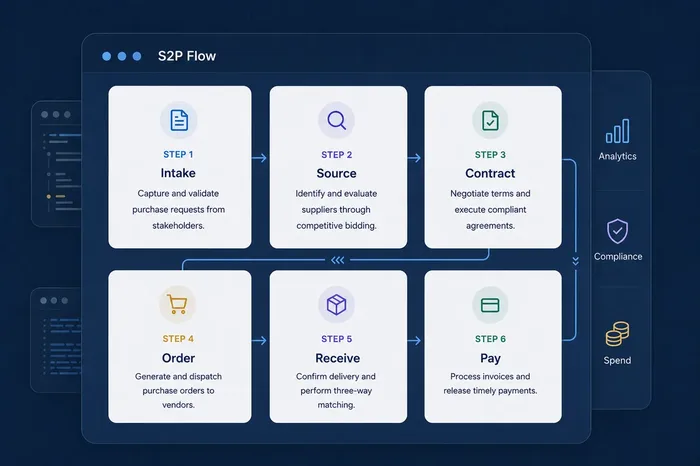
Sourcing, supplier management, contracts, invoicing and spend visibility - unified in a single procurement platform designed for the enterprise.
Structured sourcing, category benchmarks and negotiation playbooks compound into real Year-1 savings. See how one customer applied this.
Guided intake, parallel approvals and templated RFx replace weeks of manual coordination.
One live source of truth for supplier profiles, qualifications, risk signals and performance history.
Policy-aware workflows and immutable audit trails on every decision, approval and payment.
RFx, e-Auctions, evaluation and AI-guided negotiation.
Learn moreDiscovery, onboarding, qualification, risk & performance.
Learn moreAutomated classification and category insight.
Learn moreTouchless invoice processing and three-way match.
Learn moreGuided demand capture with routing to the right workflow.
Learn moreRequisitions, approvals, purchase orders, receipts and invoice matching run natively on the same platform as sourcing and supplier data - so P2P execution reflects the deals your sourcing teams actually negotiated.
Every request is routed to the right catalog, contract or sourcing path - before it becomes a rogue PO.
Policy-aware routing with delegation, out-of-office fallbacks and audit trails.
Auto-match PO, GRN, service entry sheets and invoice - with ASN visibility ahead of receipt, tolerance controls and exception queues.
From demand capture through supplier selection to contract execution - with the same policy engine, data model and reporting used downstream in P2P.
Intake and category templates enforce the right sourcing path - competitive, contracted or catalog.
Multi-attribute scoring, TCO models and bid comparison - with an audit trail from criteria to award.
Awards flow straight to contract templates, clause libraries and e-sign - no re-keying.
Source-to-Pay is two halves. Source-to-Contract decides who you buy from and on what terms; Procure-to-Pay executes against those terms. Most organisations run both. Far fewer run them as one cycle, and the gap between the halves is where the value negotiated upstream quietly fails to arrive downstream. Our neutral explainer on Source-to-Pay software defines the category and how it differs from P2P, S2C and e-procurement.
The leak has a consistent shape. A rate is agreed in a sourcing event and fixed in a contract. Weeks later a requisition is raised by someone who cannot see that contract, so it is bought at list price from a supplier who happened to be set up. The saving was real; it simply never reached a transaction. Nobody notices, because the two systems each report success on their own terms - the event closed well, the order was processed correctly.
The same disconnect runs the other way. Invoice exceptions cluster in categories where the specification was loose at sourcing, but AP has no visibility of the sourcing decision and procurement never sees the exception rate, so a problem created upstream is absorbed downstream indefinitely.
Running both halves on one platform closes the loop in three specific places: requisitions resolve against live contracts rather than a repository nobody opens, purchase orders carry the negotiated terms rather than restating them, and matching runs against the order that the award actually produced. The reporting consequence is the useful one - how much of what we negotiated actually landed? stops being a reconciliation project and becomes a query.
For procurement, category strategy becomes operational: a classification decided in a spend review changes what happens when someone raises a request, rather than sitting in a deck.
For finance, the savings figure becomes traceable to transactions, which is the difference between a number that is reported and a number that is believed.
For the business, the compliant route is the fast route, which is the only reliable way to reduce off-contract buying.
What it does not do. Consolidating the cycle will not fix an unclear category strategy, absent spend data or a policy the organisation has not agreed. Those are prerequisites, and it is worth testing them honestly before a selection process starts rather than expecting a platform to supply them.
We'll walk through the exact S2P slice that matters for your business.