
SAP-first integrations
Deep bidirectional connectors with SAP ECC and S/4HANA plus REST APIs for everything else.
IntegrationsSourcing, supplier management, contracts, invoices, spend analytics and AI-assisted decisioning - on a single platform designed for enterprise procurement teams.
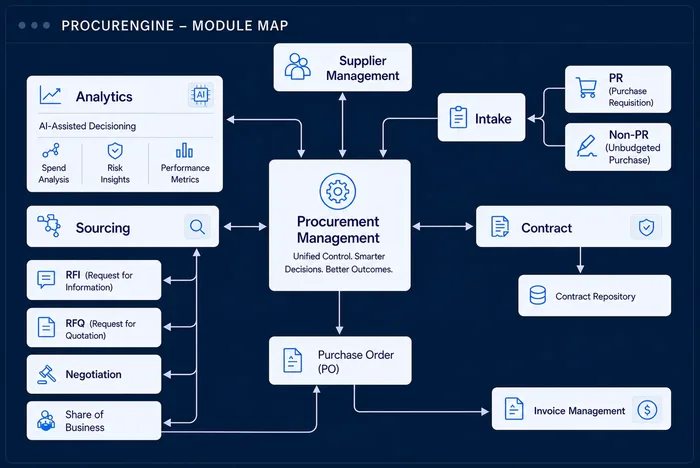
Every capability shares a common data model, workflow engine and governance layer. Start with one module and scale - or roll out the full suite.
Structured RFx, e-Auctions, evaluation frameworks and AI-guided negotiation.
What changes. Events run to a repeatable format with the evaluation recorded, instead of living in spreadsheets and email threads.
What moves. Suppliers competing per event, and the share of categories that go to market at all.
Learn moreDiscover, onboard, qualify and monitor suppliers with risk intelligence.
What changes. One live supplier record replaces the separate lists sourcing, quality and finance each keep.
What moves. Time to onboard a new supplier, and how much spend sits with unqualified vendors.
Learn moreAutomated classification, benchmark views and inflation impact modeling.
What changes. Transactions are classified against the same categories sourcing runs events in, so analysis and action share a vocabulary.
What moves. Share of spend that is classified, and how much of it is addressable.
Learn moreGRN, service entry sheets, three-way matching and ASN.
What changes. What was negotiated is what gets ordered and received, because the PO is raised against the awarded event.
What moves. Value leaking between the award and the order.
Learn moreTouchless invoice processing, three-way match and audit-ready workflows.
What changes. Matching happens against the PO and receipt already on the platform, so exceptions are the only thing a person touches.
What moves. Share of invoices clearing without manual handling, and days to close.
Learn moreGuided intake, policy-aware routing and cross-system workflow orchestration.
What changes. Requests are routed by policy from the moment they arrive, rather than being classified after the fact.
What moves. Requisition-to-PO turnaround, and how much spend arrives without a request.
Learn more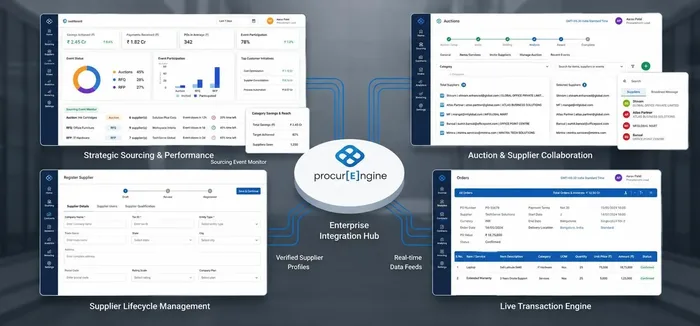
Most suites make this claim. It is worth being specific about what is shared, because that is what decides whether a module you add later inherits anything or starts from scratch.
The practical consequence is the one procurement teams care about: value negotiated in a sourcing event is still visible when the order is raised and the invoice is matched, because all three are looking at the same award.
Nobody deploys ten modules at once. Two starting points account for most rollouts, and they lead in different directions.
Start with sourcing when the pressure is commercial - categories renewing without competition, savings that need defending in front of finance. Competitive events are self-contained: they need a supplier list and a category, not a finished P2P stack. This is where most procurEngine deployments begin, and it is where the platform has the longest track record.
Start with intake and orchestration when the pressure is operational - requests arriving by email, approvals that nobody can locate, spend appearing after the commitment is made. Orchestration governs the front door first and pulls sourcing in behind it.
Either path can extend into supplier management, purchase order execution, invoice automation and spend analytics as the case for each is made. Because the supplier record, category structure and policy layer are already in place, a module added in year two inherits them rather than importing its own copy.
Sequencing is scoped per deployment against your ERP landscape and where the commercial pressure actually is - it is a conversation during evaluation, not a fixed path.
Deep bidirectional connectors with SAP ECC and S/4HANA plus REST APIs for everything else.
IntegrationsRBAC, MFA and encryption in transit and at rest by default, with full audit trails on every workflow.
Security posturePurpose-built AI for procurement - intake, negotiation, supplier discovery and spend intelligence.
AI platform45 minutes, adapted to your industry and process focus.