
One front door
A single guided intake experience, no matter how many downstream systems exist.
Guided intake captures what a requester actually needs and routes it automatically - to a catalog, an existing contract, or a new sourcing event - before it turns into a rogue purchase.
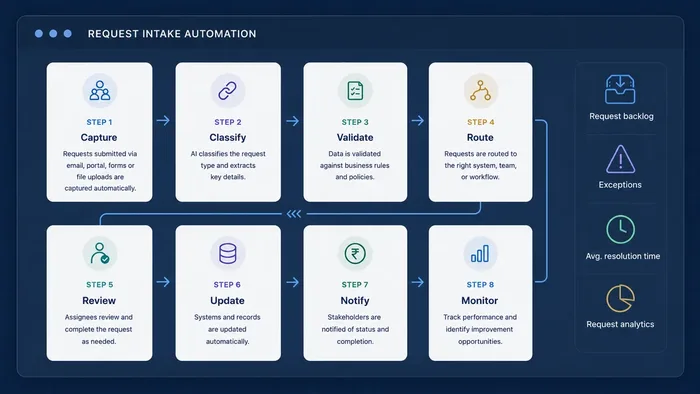
A single guided intake experience, no matter how many downstream systems exist.
Requests routed to preferred suppliers and contracts at the point of request.
Simple requests resolve in minutes via catalog; complex ones route to sourcing automatically.
A consumer-grade request experience instead of a confusing ticket form.
Adaptive questions based on category, spend level and business unit.
Requests match to catalog items, existing contracts, or a new sourcing event.
Requesters see real-time status without chasing procurement for updates.
Before intake is structured, requests arrive however the requester chooses: an email to a buyer they know, a ticket in the service desk, a spreadsheet row, a conversation. Each arrives with different information, and the first thing procurement does with any of them is ask questions that could have been asked at the point of request.
That triage cost is visible. The cost that is not visible is the request that never reaches procurement at all like the one bought on a card, or against a supplier who happened to be set up, because asking felt slower than acting. By the time it appears in spend analytics it is a data point, not a decision anyone can influence.
A single guided front door changes the economics of asking. The requester answers plain questions about what they need rather than choosing a document type, and the platform resolves it: a catalogue item, an existing contract, a new sourcing event, or a policy exception routed to a human. Simple requests complete in minutes; complex ones arrive at procurement already scoped.
Intake is also where category strategy becomes operational. A classification decided in a spend review only changes behaviour if it changes what happens when someone asks for something, which is precisely what the routing rules encode.
Who uses it. Everyone who needs to buy something, most of whom use it a few times a year and should not need training. Buyers use the other side of it: requests arriving scoped, classified and routed.
What it connects to. Catalogues, existing contracts, the supplier master. And when nothing existing fits, a new sourcing event. Downstream it feeds requisitions and orders, so the routing decision made at intake carries all the way to the invoice.
What it does not do. It cannot make a catalogue or contract exist. If the compliant option genuinely is not there, good intake surfaces that as a sourcing trigger rather than pretending otherwise.
Guided intake, shown on your own categories.