
1 · Award
What finance can verify here is not the saving but the comparison the price came from. A price with no comparison behind it is an assertion; a price that beat four others in a recorded event is an observation.
procurEngine · 19 August 2026
The finance objection to procurement software is rarely about procurement. It is that the savings figure arriving from procurement cannot be reconciled to anything in the ledger. A number is reported, finance cannot trace it to transactions, and the two functions end up negotiating about the number rather than acting on it.
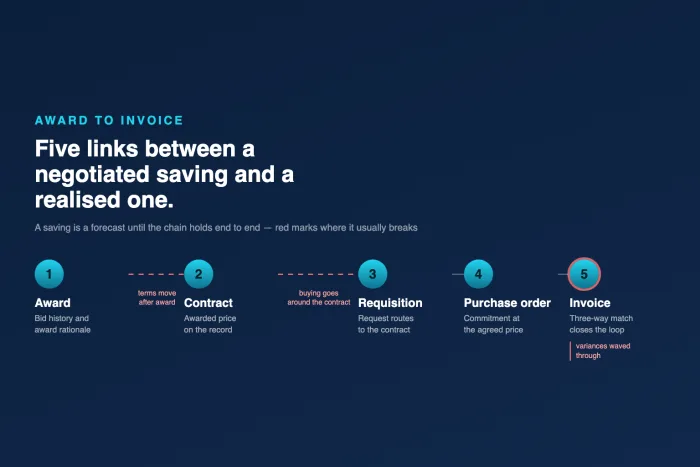
That gap is structural rather than political. A saving agreed in a sourcing event is a forecast. It becomes a realised saving only if the requisition routes to the contract that carries the negotiated price, the purchase order is raised at that price, and the invoice matches. Each of those is a separate system event, and each is a place the chain can break without anyone noticing.
No reporting layer repairs a broken chain. A dashboard built on top of disconnected events produces a confident number with nothing underneath it, which is precisely what finance has learned to discount.
The useful question is not “what did we save?” but “at which point can I check?” There are five, and each leaves a different kind of evidence.
What finance can verify here is not the saving but the comparison the price came from. A price with no comparison behind it is an assertion; a price that beat four others in a recorded event is an observation.
That the price awarded is the price contracted. This link fails more often than people expect, usually through renegotiation after award that never makes it back into the reported number.
Whether buying went to the contract or around it. The weakest link in most organisations, and the most consequential: spend that bypasses the agreement still looks entirely compliant in the ledger.
Timing, more than price. The commitment is visible before the invoice arrives, which is the difference between a forecast that reflects reality and one that is always a month behind.
That the price paid is the price agreed. Where the three-way match holds, the saving is no longer a claim. It is arithmetic.
The failures cluster in three places, and none of them is the sourcing event everyone focuses on. The guide names all three and what each does to the reported number.
Tying savings to a verifiable chain almost always makes the number smaller. That is the right trade, and it is worth saying plainly to whoever owns the target.
A large figure that cannot be reconciled costs credibility every time it is questioned, and it is questioned in every meeting where budget is allocated. A smaller figure that survives audit is spendable: it can be taken to a board, held against a forecast, and used to argue for the next investment. The first number wins the presentation; the second wins the argument.
Finance leaders who are asked to accept a savings number they cannot trace, and procurement leaders who would rather report a smaller figure that survives the question.
The full guide takes each of the five links in turn (what happens there, what finance can verify, and what to look for), then names the three places the chain usually breaks and gives five questions to put to your procurement team.