
Negotiating with Bottleneck Suppliers: Secure Supply Without Giving Away Control
By Anupam Aggrwal, CEO & Co-Founder · 14 April 2026
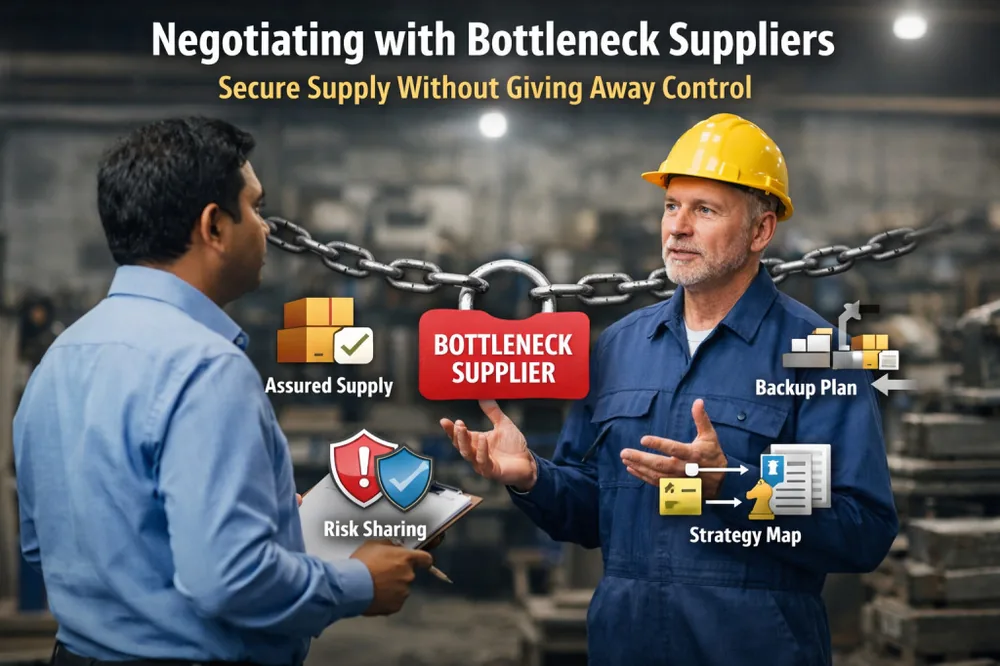
In procurement strategy, bottleneck suppliers occupy a deceptively dangerous position – yet they rarely receive the attention they deserve until a crisis forces the issue. They typically account for a small share of total spend, yet supply items or services that are highly specialized, difficult to source elsewhere, and critical to operational continuity.
Bottleneck suppliers are characterized by low purchasing value but high supply risk, giving them disproportionate leverage over buyers simply because alternatives are scarce and switching costs are prohibitive. When one of them falters, the ripple effect is swift and costly: production slows, customer commitments are missed, and alternative options are few and far between. The uncomfortable truth is that most procurement leaders underestimate this vulnerability – until it’s too late to act.
If you want a simple way to classify your categories, you can refer to the Kraljic Matrix.
Examples of Bottleneck Items in Kraljic Matrix
Consider a few everyday scenarios that bring this to life. Appointing a Legal Representative for your company in a foreign jurisdiction, engaging a notary authorized for specific cross-border transactions, sourcing a custom-engineered component with a single qualified manufacturer, or retaining a niche regulatory consultant whose certifications only a handful of professionals in the market possess. None of these engagements are significant in spend – yet the absence of any one of them at the desired time can quietly bring critical operations, approvals, or project milestones to a complete halt. Small line items on a procurement report, but outsized consequences when they fail to deliver.
In my experience, negotiating with these suppliers is not about squeezing price. It is about securing supply while protecting your long-term control.
This is my third blog on this topic, where I have covered different categories. The links to the other categories are as follows:
Strategic Items: Negotiating with Strategic Suppliers: Protect Your Position Without Damaging the Relationship
Leverage Items: Negotiating with Leverage Suppliers: Maximize Savings Without Overplaying Your Hand
Routine Items: Negotiating with Routine Suppliers: Cut Costs and Complexity at the Same Time
Let us get into a practical, step by step approach that you can apply immediately.
Step 1: Identify your true bottleneck exposure
Start with clarity. Many teams misclassify categories. Look at items where supply disruption can stop operations, even if the spend is small. Check supplier concentration, lead times, and availability of substitutes.
Create a simple list of top 10 bottleneck items. This alone will give you better visibility than most organizations have.
Step 2: Understand why the supplier holds power
Do not negotiate blindly. Ask simple questions. Is it technology, capacity, certification, geography, or relationship lock in that gives them leverage.
Once you understand the source of power, you can start designing your response. Without this clarity, negotiation becomes reactive.
Step 3: Shift the objective from price to continuity
With bottleneck suppliers, your first goal is supply assurance. Price comes second.
Instead of pushing for discounts, negotiate for:
- Assured capacity allocation
- Priority production slots
- Shorter lead times
- Emergency support clauses
These create far more value than a small cost reduction.
Step 4: Build a dual track sourcing plan
Even if there is only one viable supplier today, start working on alternatives. This could be
- Developing a secondary supplier
- Working with engineering to redesign specifications
- Exploring near substitutes
This is not immediate. But over 6 to 12 months, it changes your negotiation position completely.
Step 5: Use volume commitment carefully
Volume commitment can be a useful lever, but only if you protect flexibility. Instead of fixed commitments, negotiate bands or ranges. This ensures supplier confidence while giving you room to adjust.
Avoid locking yourself into rigid contracts that increase dependency.
Step 6: Negotiate transparency, not just terms
Ask for visibility into the supplier’s constraints. Capacity plans, raw material dependencies, and lead time drivers.
When suppliers see you as a serious partner, they are more open. This transparency helps you plan better and reduces surprises.
Step 7: Define risk sharing mechanisms
Do not carry all the risk. Build simple clauses like
- Buffer stock agreements
- Penalty for critical delays
- Shared inventory planning
Keep it practical. The goal is not legal complexity. It is operational clarity.
Step 8: Build a long term supplier strategy map
This is where most teams stop, but this is where control is built. Create a simple strategy map for each critical bottleneck supplier
- Current dependency level
- Alternative development plan
- Commercial model evolution
- Relationship approach
Review this every quarter. Over time, your dependence reduces and your negotiating position improves.
Step 9: Keep the relationship professional, not emotional
Bottleneck suppliers often become sensitive relationships. Teams hesitate to push back.
Stay respectful but firm. You are not dependent by choice. You are managing a situation. The tone should reflect partnership, not submission.
Where procurEngine fits in
If you are finding it difficult to clearly identify your bottleneck suppliers or build a practical mitigation plan, we are happy to help. We work closely with procurement teams to map critical dependencies, structure negotiation strategies, and create simple, actionable plans that reduce risk without adding complexity.
Learn more at www.procurEngine.com
People Also Ask
How do you manage bottleneck items in procurement
Identify critical items, secure supply through agreements, and develop alternatives over time.
What is the best negotiation strategy for limited suppliers
Focus on continuity, build transparency, and gradually reduce dependency rather than forcing price reductions.
Why are bottleneck suppliers risky
Because supply disruption can impact operations and there are limited or no immediate alternatives.
How can procurement reduce supply risk
By diversifying suppliers, improving planning, and building long term supplier strategies.
What role does supplier relationship play in bottleneck categories
A strong professional relationship improves transparency, responsiveness, and supply reliability.
Questions about this article.
What are bottleneck suppliers in procurement
Should procurement focus on cost reduction with bottleneck suppliers
How can I reduce dependency on a bottleneck supplier
What is the biggest mistake in negotiating with bottleneck suppliers
How often should bottleneck strategies be reviewed
Can contracts alone solve bottleneck risks
About the Author
Anupam Aggrwal is the CEO and Co-Founder of procurEngine and has spent more than 25 years handling negotiations and helping organizations improve procurement performance through process transformation, digitalization, and strategic sourcing. He also gives guest lectures to supply chain students at Mays Business School at Texas A&M University and the Eli Broad Graduate School of Management at Michigan State University.