
How to Apply the Kraljic Matrix – 20 Real Procurement Categories in an EPC Company
By Anupam Aggrwal, CEO & Co-Founder · 6 April 2026
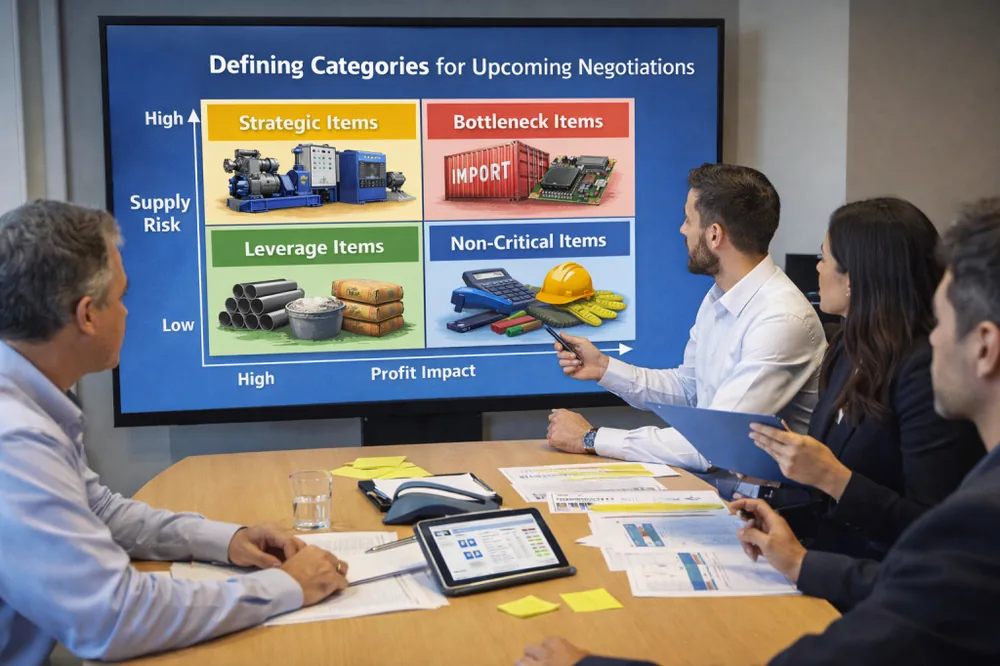
Classifying your procurement categories correctly is the foundation of any effective negotiation strategy – and the Kraljic Matrix is one of the most powerful frameworks I have come across to do exactly that. But knowing the framework is not the same as applying it. The real challenge is putting it to work on your actual spend, category by category, in the middle of a busy procurement cycle.
Having worked closely with procurement leaders across EPC and manufacturing companies, I have seen the same gap repeatedly. The framework is understood; the application is not. Teams default to gut feel or past practice when the pressure is on, and the strategic value of category management gets lost.
This blog is designed to close that gap.
I will walk you through 20 real procurement categories from a mid-sized EPC company and show you how to classify each one – with clear reasoning you can adapt to your own context. If you need a refresher on the matrix itself, start here: How to Transform Your Supplier Negotiation Strategy Using the Kraljic Matrix.
One important caveat: the classifications below are for illustration purposes only. In practice, categories shift between Strategic, Leverage, Bottleneck, and Non-Critical depending on your business context, project requirements, market conditions, and supplier dynamics. Use this as a thinking tool, not a fixed template.
Step 1: Start with your top spend categories
Do not try to cover everything. Start with your most relevant categories. Below are 20 common categories in an EPC setup.
- Steel
- Cement
- Structural fabrication
- Electrical panels
- Cables and wiring
- Pumps and compressors
- Valves and fittings
- Specialized process equipment
- Construction chemicals
- Subcontracted civil work
- Subcontracted mechanical work
- Engineering design services
- Project management consultants
- Logistics and transportation
- Imported components
- IT software licenses
- Safety equipment
- Office supplies
- Temporary site facilities
- Maintenance spares
Step 2: Classify each category based on impact and risk
Now let us apply the Kraljic thinking to each one. Keep it practical. Do not overanalyze.
1. Steel – Leverage item
Steel has high impact on project cost, but there are usually multiple suppliers available. This gives you negotiation power and makes it suitable for competitive sourcing.
2. Cement – Leverage item
Cement is a major cost driver in construction, but supplier availability is typically high in most regions. You can drive pricing through volume consolidation.
3. Structural fabrication – Strategic item
Fabrication quality directly impacts project timelines and safety. Supplier capability varies significantly, and switching is not easy once work starts.
4. Electrical panels – Strategic item
Panels are often customized and integrated into the system design. Limited qualified suppliers and high dependency make this a strategic category.
5. Cables and wiring – Leverage item
This is a high value category but widely available. Standard specifications allow you to run competitive bids and negotiate effectively.
6. Pumps and compressors – Strategic item
These are critical to plant operations. Supplier selection depends on performance reliability, and there are limited proven vendors.
7. Valves and fittings – Leverage item
Although important, these are generally standardized and available from multiple suppliers, allowing strong negotiation leverage.
8. Specialized process equipment – Strategic item
This is typically sourced from a few global suppliers. High technical complexity and long lead times increase supply risk.
9. Construction chemicals – Leverage item
These impact quality but are available from several established suppliers. Switching is possible with proper validation.
10. Subcontracted civil work – Strategic item
Execution quality and timelines depend heavily on subcontractors. Finding reliable partners is not easy, making this high risk.
11. Subcontracted mechanical work – Strategic item
Similar to civil work, this depends on skilled execution and coordination. Supplier capability and availability drive the risk.
12. Engineering design services – Strategic item
Design errors can have a cascading impact on the entire project. Trusted partners are limited and switching mid project is difficult.
13. Project management consultants – Bottleneck item
While not a large cost driver, availability of the right expertise can be limited. Delays in onboarding can impact project execution.
14. Logistics and transportation – Leverage item
This is a significant cost area but there are multiple service providers. You can optimize through rate contracts and competition.
15. Imported components – Bottleneck item
These are often low in value but high in risk due to dependency on global supply chains and long lead times.
16. IT software licenses – Leverage item
Costs can be high, but there are usually multiple vendors or alternatives available. Negotiation and bundling can help reduce cost.
17. Safety equipment – Non critical item
This is essential but low in cost and widely available. The focus should be on standardization and easy procurement.
18. Office supplies – Non critical item
Low value and low risk. Best handled through catalogs or automated purchasing.
19. Temporary site facilities – Leverage item
Moderate cost and multiple suppliers. Can be sourced competitively with clear specifications.
20. Maintenance spares – Bottleneck item
Individually low value but critical for operations. Availability can be uncertain, especially for older equipment.
Step 3: Apply the right strategy for each category
Once you classify your categories, the right strategy becomes self-evident. Yet this is precisely where most procurement teams leave value on the table – they complete the classification exercise and stop there, without translating it into differentiated action.
Leverage Items (e.g., steel, cables) These categories offer the most immediate negotiation upside. Drive them through competitive sourcing, volume consolidation, and structured negotiation. Use your buying power deliberately – do not let these become routine reorders.
Strategic Items (e.g., fabrication, pumps, subcontracting) Price is not the primary lever here. Focus on building long-term supplier relationships, setting clear performance metrics, and fostering collaboration. The goal is reliability and joint problem-solving, not just cost reduction.
Bottleneck Items (e.g., imported components, critical spares) The priority is risk mitigation. Identify and qualify backup suppliers before you need them, maintain adequate buffer stock, and monitor lead times closely. A single supply disruption in this category can stall an entire project.
Non-Critical Items (e.g., office supplies, consumables) Reduce the effort your team spends here. Automate where possible, consolidate suppliers, and simplify the buying process. Every hour saved on non-critical items is an hour your team can invest in categories that truly move the needle.
The underlying principle is simple: not all categories deserve the same attention. The Kraljic Matrix tells you where to compete hard, where to partner deeply, where to build resilience, and where to automate and move on.
Step 4: Review your classification regularly
One thing I have learned from working across multiple procurement cycles: classification is not a one-time exercise. Categories shift – sometimes gradually, sometimes overnight.
A leverage category like steel can quickly become a bottleneck when a key supplier faces capacity constraints, a port disruption delays imports, or geopolitical tensions tighten raw material availability. What felt like a buyer’s market last quarter may look very different today. I have seen this play out repeatedly in EPC environments where project timelines leave little room for supply surprises.
This is why I strongly recommend making category classification a quarterly exercise. Set aside a few hours with your team, revisit your top spend categories, and ask one simple question: has anything changed in the market, in our supply base, or in our business requirements that would shift this category’s position on the matrix? That conversation alone is often enough to surface risks before they become disruptions.
A few practical tips to keep it manageable:
- Keep it focused. You do not need to review every category every quarter. Prioritize your top 20 to 30 spend categories and any categories that showed supply stress in the previous period.
- Involve your category owners. The people closest to the suppliers and the market will have the most relevant signals.
- Document your reasoning. Not just the classification, but why you placed it there. This makes the next review faster and more grounded.
- Act on the shifts. A reclassification only creates value if it triggers a change in strategy or sourcing approach.
The goal is not to build a perfect model. The goal is to keep your procurement strategy aligned with reality. Do not turn this into a complex consulting project – a practical, living classification that your team actually uses will always outperform a beautifully structured one that sits in a presentation deck.
Where procurEngine fits in
Knowing your category classification is only half the equation. The other half is having the right tools to execute the strategy that follows.
Once you have selected your category, procurEngine helps you act on it with speed and structure, seamlessly connected with your ERP. Access over 200 negotiation strategies, connect with as many suppliers as needed without increasing your team’s workload, and maintain a complete auditable record of every procurement event, including offers, negotiations, and approvals.
It is designed for procurement teams that want control and clarity without complexity. No lengthy implementation, no dedicated IT support, just a faster and more structured way to execute your category strategy.
Questions about this article.
How many spend categories should I classify to get started?
Can a category change quadrants over time?
What is the right strategy for bottleneck items?
What is the biggest mistake teams make after classifying categories?
About the Author
Anupam Aggrwal is the CEO and Co-Founder of procurEngine and has spent more than 25 years handling negotiations and helping organizations improve procurement performance through process transformation, digitalization, and strategic sourcing. He also gives guest lectures to supply chain students at Mays Business School at Texas A&M University and the Eli Broad Graduate School of Management at Michigan State University.